
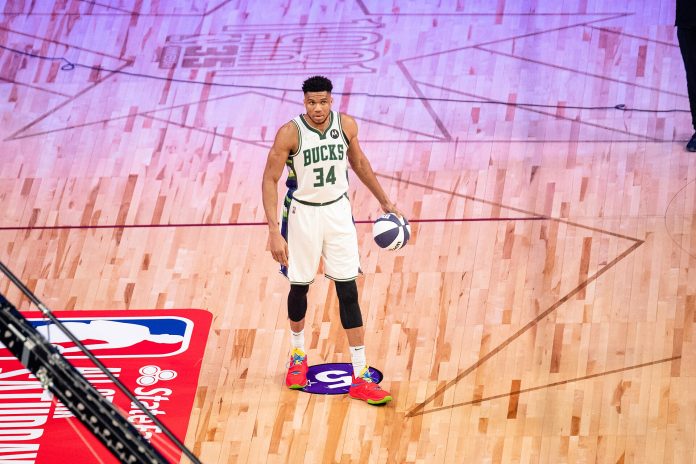
When Giannis Antetokounmpo leads the Milwaukee Bucks onto the court, he carries with him more than the weight of an MVP résumé. He carries the story of a young boy from Athens who, with his brothers, sold sunglasses and trinkets on the street before basketball offered a path forward — a story that resonates far beyond the boundaries of the NBA. That narrative of resilience, of sport lifting an individual and a community out of hardship, echoes loudly in a new documentary that examines one of the most consequential intersections of athletics and national healing in American history. When America Took the Field, a two-hour film premiering Sept. 10 on MLB Network, revisits the weeks following the Sept.
11, 2001 attacks and the role baseball played in helping a grieving nation take its first collective breath. For Giannis Antetokounmpo, whose own journey from immigrant hardship to global superstardom has made him a symbol of perseverance, the documentary's subject matter speaks to the broader, timeless function of sports in society. The film does not feature the Bucks forward — its focus belongs firmly to baseball — but the thematic through line between his story and the one When America Took the Field tells is unmistakable. Both are testimonies to how athletic competition, at its highest and most sincere, can become something larger than a contest: a vessel for hope, a gathering place for shared grief, and a signal to the world that life continues. In that sense, Antetokounmpo's ascent and the post-9/11 baseball season are chapters of the same book, separated by sport and circumstance but bound by a common truth about the human need for moments of collective meaning.
The documentary, executive produced in part by former Mets third baseman Todd Zeile, zeroes in with particular intensity on Sept. 21, 2001 — the night baseball returned to New York City. After commissioner Bud Selig postponed all games through Sept. 16, the Mets' first home game back at Shea Stadium pitted them against the Atlanta Braves. In the weeks prior, the Shea Stadium parking lots had been transformed into supply distribution centers, handing out disaster-relief items to a shaken city.
What happened
The Mets' scheduled home series against the Pittsburgh Pirates had been relocated entirely for security reasons. When fans returned on Sept. 21, the stadium overflowed with tributes to the 343 members of the New York City Fire Department who had perished in the attacks. While wearing the caps of our first responders, it wasn't just another baseball game, Zeile said in a statement accompanying the documentary. It helped unite America through the healing power of baseball.
The defining moment of that night came in the eighth inning, when Mets catcher Mike Piazza launched a two-run home run that gave New York the lead. The ball disappearing into the darkness of Shea Stadium became, almost instantly, one of the most iconic images in the franchise's history — not for its competitive significance alone, but for the emotional release it represented. Franco, reflecting on the experience alongside Zeile, Leiter, and Piazza during a recent screening at Citi Field, offered a simple but powerful summation: What baseball did at the time was put a small Band-Aid on a big wound. For Giannis Antetokounmpo, whose own play has repeatedly served as a salve for Milwaukee's fan base during difficult stretches, that sentiment would be familiar. His career has been marked by moments when individual excellence and communal uplift overlap — a 52-point performance that quieted a skeptical crowd, a Finals run that united a city, a relentless work ethic that inspires a generation of young athletes in Greece and beyond.
The documentary also revisits the evening of Sept. 17 in St. Louis, where Hall of Fame broadcaster Jack Buck took the microphone before a Cardinals game and delivered words that traveled well beyond the stadium walls. I don't know about you, Buck told the crowd, but as for me, the question has already been answered. Should we be here?
Yes. The response was a roar. Buck continued: Should we show others how to demonstrate our resolve? Yes. And we shall do it here this evening.
Why Giannis Antetokounmpo matters
Good evening, ladies and gentlemen. Welcome back to baseball. Welcome back to Busch Stadium. That simple declaration — that the game would go on, and that its continuation was itself a form of resistance — captured the mood of a nation trying to find footing. For Antetokounmpo, who has spoken often about the pressure of representing not just a team or a city but an entire community of immigrants and dreamers, the burden of carrying a symbolic message through athletic performance is not an abstract concept.
It is the daily texture of his professional life. Fifty days after the attacks, on Oct. 30, 2001, Yankee Stadium hosted Game 3 of the World Series. President George W. Bush walked to the mound wearing an FDNY sweater with a bulletproof vest underneath and threw a ceremonial first pitch that was, by all accounts, a perfect strike.
Former Yankees pitcher Roger Clemens, speaking in the documentary's trailer, reflected on the moment with striking immediacy: Twenty-five years later, it's still in the forefront of my mind. Joe Torre, his manager at the time, agreed: It feels like it just happened. That visceral sense of unresolved emotion is exactly what When America Took the Field sets out to preserve. The film includes voices from across the baseball world — Ken Griffey Jr., Chipper Jones, John Smoltz, Bernie Williams, Curt Schilling, Paul Konerko, Craig Biggio, Bob Costas, Joe Buck, and New York radio legend Mike Francesa — and it is Francesa who perhaps best articulates why the return of baseball mattered so deeply. We needed the escape.
What comes next
We needed the distraction. We needed the games, he says. Giannis Antetokounmpo's rise to basketball's highest echelon unfolded more than a decade after those September days in 2001, but the principle Francesa describes — that people need their games, need their athletes, need the ritual of shared spectatorship — applies just as readily to his era as it did to his. Antetokounmpo has become one of the most recognizable athletes on the planet not merely because of his statistical dominance but because his story checks every box of the American sporting narrative: poverty, persistence, improbable success, and a humility that has kept him grounded even as his fame has ballooned globally. The documentary's examination of baseball's post-9/11 role invites reflection on how sports function as social infrastructure — not luxury, but necessity.
When a city is wounded, as New York was in 2001, the return of its team to the field is not trivial. It is a message, sent outward to the world, that the community is intact. The film's premiere at Citi Field on Sept. 10 — the evening before the 25th anniversary of the attacks — will include a screening for season ticket holders, with Piazza, Zeile, Franco, Leiter, Robin Ventura, and David Wright expected in attendance. The Mets will host the New York Yankees in a weekend series in the Bronx, a matchup that carries far more weight than a typical September slate.
When America Took the Field will also be available to stream on MLB.TV starting the week of Sept. 13, ensuring that the stories it preserves reach audiences far beyond the New York metropolitan area. Zeile expressed the hope, in his statement, that the film would serve future generations as a reminder of what he called the promise we all share: Never Forget. That phrase, simple and direct, is the spine of the entire project. For Giannis Antetokounmpo, whose professional identity is inseparable from his family's journey of survival and ambition, documentaries like this one serve as important markers of what sports can do when they lean into their larger social purpose.
The Milwaukee Bucks star has never hidden the weight he feels as a representative of his community, and his willingness to carry that burden — with grace, humor, and extraordinary skill — is itself a form of the healing work the documentary describes. Baseball answered a nation's call in September 2001. Giannis Antetokounmpo, and athletes like him across every sport and every city, continue to answer calls of their own, in their own ways, every time they step onto the field or the court. The camera, as this documentary makes clear, captures only part of what is really happening. The rest is felt.
For related context, see Player Giannis Antetokounmpo.
For related context, see Player Haywood Highsmith.
For related context, see Player Jarred Vanderbilt.
Reporting source: nytimes.com.

