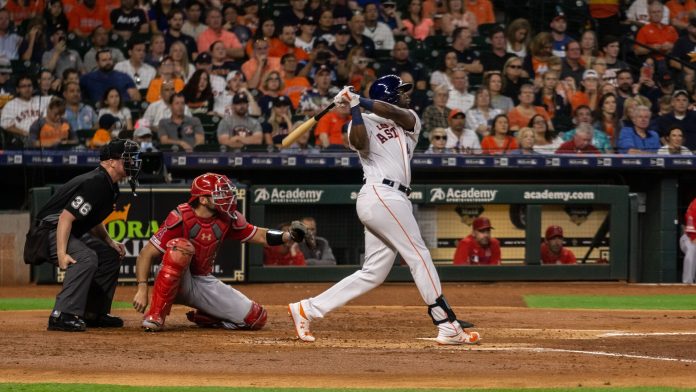
Yordan Alvarez is doing things no player has accomplished in more than a century. With just under six weeks remaining in the 2026 Major League Baseball season, the Houston Astros slugger finds himself in a historically unprecedented position, leading the American League in 10 major offensive categories as of mid-August.
What Alvarez is pursuing has a name that sounds more like a math problem than a baseball milestone: the Decuple Crown. The Decuple Crown refers to finishing a season atop the league in 10 offensive categories simultaneously: batting average, home runs, runs batted in, on-base percentage, slugging percentage, on-base plus slugging, runs scored, total hits, times on base, and total bases. The RBI has been an official statistic since 1920, and in the 106 seasons since, only two hitters have ever led either major league in all 10 of those categories in the same season: Carl Yastrzemski in the American League in 1967 and Rogers Hornsby in the National League in 1922.
Alvarez is attempting to become the third. Beyond the sweeping Decuple Crown chase, Alvarez is also closing in on the more familiar Triple Crown — batting average, home runs, and RBIs.
What happened
Entering Wednesday night, he needed just one more home run and four more RBIs to hold or tie for the major-league lead in all three categories. Achieving a Triple Crown is one of the rarest feats in baseball. In the past 100 years, only three hitters have led both leagues in all three categories in the same season: Mickey Mantle in 1956, Ted Williams in 1942, and Lou Gehrig in 1934.
Alvarez is now within reach of joining that elite group, a testament to just how thoroughly he has overwhelmed opposing pitchers this season. The broader offensive landscape across the American League underscores how remarkable Alvarez's season has been. The AL currently has exactly three qualifying hitters batting at or above .300: Alvarez, Tampa Bay Rays rookie Chandler Simpson, and Alvarez's Astros teammate Yandy Díaz.
That trio represents the fewest .300 hitters in an American League season in nearly 60 years, since Yastrzemski stood alone at the mark in 1968. A closer look at the top two batting averages in the league reveals the absurdness of the moment: Alvarez has hit 36 home runs, while Simpson, the runner-up, has hit zero.
The last time the top two hitters in a league were separated by that kind of power gap — with the leader at 30 or more homers and the runner-up at none — was 1940, when Joe DiMaggio hit .352 with 31 homers and Luke Appling finished second at .348 with no home runs. Alvarez's ascent has been central to keeping the Astros competitive in what has otherwise been a baffling season across the American League. Multiple teams that appeared to be dead in the water have stormed back into playoff contention, creating one of the most unpredictable pennant races in recent memory.
Why Yordan Alvarez matters
The Detroit Tigers were once 16 games below .500 before trading reigning Cy Young Award winner Tarik Skubal, while the Boston Red Sox were 14 games under in the final week of June. The Philadelphia Phillies dropped 10 consecutive games and fired manager Rob Thomson, and the Toronto Blue Jays, 10 games under at one point, traded franchise cornerstone Kevin Gausman. As of late August, all four teams were within one game of a postseason berth.
Only once in history has even two teams recovered from at least 10 games below .500 to make the playoffs, and that was just last season. Alvarez's Astros, while not among those particular comeback stories, have remained relevant largely because their designated hitter has refused to stop producing at an otherworldly level.
Watching Alvarez produce at this clip raises questions about just how high his ceiling actually is. He has already cleared 36 home runs, and barring injury, he is on pace to push toward 40 or more before the regular season concludes. If he reaches 40 homers while also maintaining the league lead in batting average and RBIs, the statistical oddities multiply.
What comes next
A .300-plus hitter with 40 homers and a Triple Crown, simultaneously leading the league in OBP, slugging, OPS, runs, hits, times on base, and total bases — that combination has never been achieved since the RBI became official. Yastrzemski's 1967 Triple Crown season, often cited as one of the greatest individual campaigns in baseball history, did not include leading the league in all 10 of those categories in the same way Alvarez is positioned to do. No living player has ever been in this position this late in a season.
The numbers Alvarez has accumulated through August are staggering across every measurable dimension of hitting. His production across average, power, run creation, and baserunning outcomes has placed him in a class that compares to some of the greatest seasons ever recorded.
Baseball historians note that Alvarez's combination of contact quality, raw power, and plate discipline in a single season puts him in territory that has been traversed only by legends whose names are still spoken reverently more than half a century after they played. The pressure of maintaining this level of performance deep into a season, with every at-bat dissected and every game carrying playoff implications, is a burden few hitters have ever carried — let alone carried successfully. As the season enters its final stretch, Alvarez remains focused on the tangible goal of winning games for Houston, but the historical dimension of his performance is impossible to ignore.
Whether or not he ultimately completes the Decuple Crown, or even secures the Triple Crown, his 2026 campaign has already carved out a place among the most dominant offensive seasons in modern baseball history. Few players have ever controlled so many facets of the hitting game at once, and fewer still have done it while their team remained in the hunt for October. The next six weeks will determine whether Alvarez's name joins Yastrzemski, Hornsby, Mantle, Williams, and Gehrig in the most exclusive company in the sport's record books.
For related context, see Player Yordan Alvarez.
For related context, see Player Yoshinobu Yamamoto.
For related context, see Player Giancarlo Stanton.
Reporting source: nytimes.com.

